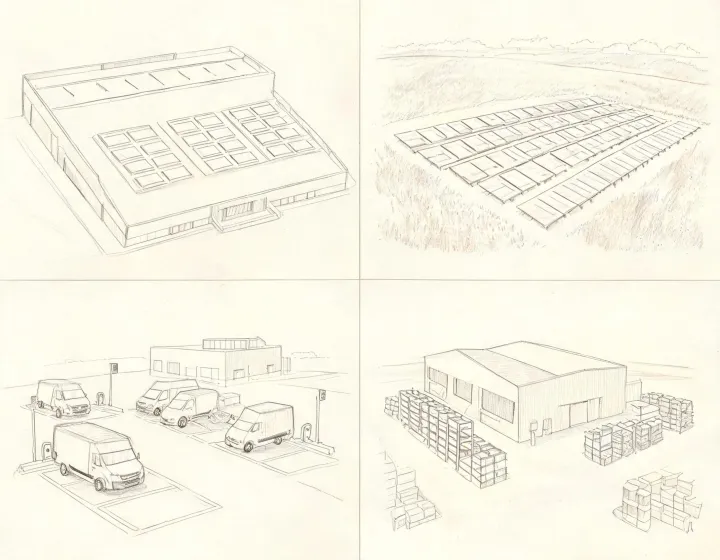
Five application question sets
Commercial rooftop storage
Application: behind-the-meter support beside an existing roof array. Interface questions: AC-coupled versus DC-coupled storage, available switchgear space, and whether the inverter is already fixed. RFQ unit: cabinet or kWh block.
Ground-mount hybrid
Application: a new array with storage on the same parcel. Interface questions: DC voltage window, collection layout and who owns the power-conversion scope. RFQ unit: container or rack line.
Fleet depot
Application: depot load beside Level 2 EVSE or DC fast charging stalls. Interface questions: demand profile, whether storage is allowed to grid-form during an outage, and the thermal path in a parking structure. RFQ unit: cabinet sized to the charger group, not to the vehicle count alone.
Industrial peak support
Application: process or HVAC peaks inside a plant. Interface questions: cycle-life basis at the expected depth of discharge, enclosure rating and the protocol into the plant controller. RFQ unit: rack or cabinet with spares called out.
Distributed energy node
Application: a small node that may island. Interface questions: grid-forming inverter pairing, communications and the unresolved interconnection path. RFQ unit: one system lot with accessories listed line by line.
Unit price versus delivered procurement scope
A low unit price can reduce equipment acquisition cost when the scope is truly equivalent. A comparable delivered scope can expose omitted accessories, logistics and documentation before award. HelioLink Sourcing records both readings and does not declare a winner from the unit column.
AC-coupled versus DC-coupled storage
| Reading | AC-coupled | DC-coupled |
|---|
| When it is discussed | Retrofit and separately controlled PV and storage | New-build layouts that share a DC path |
| What the RFQ must still name | Inverter ratings, controls and the existing array | DC voltage, conversion stages and the exact pairing |
| What this page will not decide | Code acceptance or round-trip efficiency | Structural pad design or interconnection approval |
Key fields that travel with every card: rated power, usable energy capacity, voltage, current, operating temperature and quantity. Efficiency is accepted only with a test basis. See the quote desk and the sourcing brief for the file list.
Write the site ambient window in °C, for example a winter low near -20 °C and a summer high near 45 °C, only when the project has measured it. Add maximum system voltage and MPPT limits on the module row, and name the battery management system protocol separately from any grid-forming inverter. A 100 kW depot block and a 2 MWh container are different quantity units even when both are lithium battery suppliers questions.
For a depot pilot, record the exact battery and inverter models, firmware, DC voltage window, expected rated power and usable capacity before requesting a sample. Have a qualified reviewer agree the test temperature, depth of discharge and acceptance limits, then compare the supplier report and any supervised pilot result against that same sheet. Log model mismatches, missing transport evidence and unresolved fire or interconnection approval as open items before award; this checklist is not an energized testing instruction.