Lithium battery supplier quotation fields
The quote desk turns a lithium battery supplier request into a field list that more than one factory can answer. HelioLink Sourcing does not select a winner and does not treat a returned price as accepted scope.
Start with the application, then the electrical interface. Rated power and usable capacity stay separate lines. If the project also needs an inverter or EMS, keep that line outside the battery price so omissions stay visible.
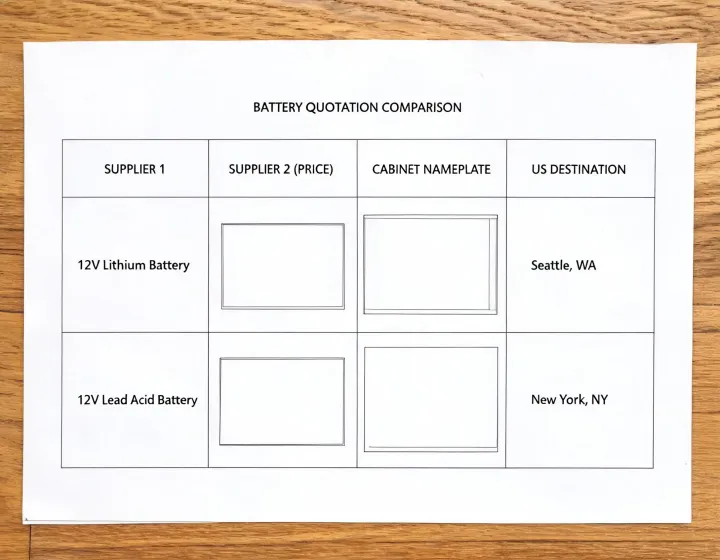
- Specification Chemistry, usable kWh, kW, DC voltage, enclosure rating.
- Quantity Count plus unit, and whether spares are in or out.
- Destination US delivery point and any site-access limit already known.
- Timing Document-return date first, equipment window second.
Four fields that make prices comparable
Specification
Same model identity, same usable capacity and same rated power before any currency is read.
Quantity
Same count and unit. A sample cabinet is not a substitute row for the project lot.
Delivered scope
Packaging, freight, duties, cables, commissioning boundary and warranty text sit beside the unit figure.
Supplier documents
Datasheet, drawing and applicable test or listing files tied to the quoted item, not to a sibling model.
Exact-item file list
Ask the lithium battery supplier contact to attach files for the model named in the quotation. A catalog page that covers a range is not that attachment.
- Current datasheet with usable capacity, rated power and DC voltage.
- Dimensional drawing and enclosure rating.
- Battery management system description and the protocol offered to the site controller.
- Thermal management method and the ambient range the supplier will stand behind.
- Where applicable, a safety-listing reference and a UN 38.3 test summary for the proposed item.
- Warranty text, exclusions and the cycle-life basis used in the sales claim.
Approvals that stay open
HelioLink Sourcing can chase the file. It cannot close a code, interconnection or fire review. Mark each item as requested, received or still open.
| Open item | Who must close it |
|---|---|
| AC-coupled or DC-coupled interface | Project electrical engineer |
| Grid-forming or grid-following behavior | Interconnection reviewer and supplier, on the exact inverter pairing |
| Indoor fire or ventilation path | Authority having jurisdiction and the design team |
| Transport mode and packaging | Supplier plus the carrier, using the item-specific file |
| Round-trip efficiency number | Supplier, with the test basis written next to the percent |
Read the inquiry options and the procurement brief if the file list is still short. Depth of discharge, if used as a buying condition, needs the same test note as cycle life.
Request the minimum order quantity separately for a pilot cabinet and for the project lot. Ask whether a sample is offered, what it costs, what its document set includes, and whether its model and firmware match the proposed supply. Record production, document review, carrier transit and destination handling as separate lead-time assumptions; none is confirmed by sending the inquiry.
Repeat buyer-supplied figures rather than inventing them. A note might already say 500 kW rated power, 1000 kWh usable capacity, a 1500 V DC bus or a 0.5 C discharge. Those are inputs. Ask which temperature, such as 25 °C, the round-trip efficiency table uses, and whether OCPP, SCADA or another protocol is in the paired-controller scope.
Send the normalized supplier request
FREE sourcing support, up to 3%. Eligibility applies to qualified business buyers and is confirmed after we review your product, quantity, destination, and sourcing requirements.
Include the lithium battery supplier configuration you want quoted, the quantity, the US destination and the document list above. Optional budget uses a currency and a per-unit or whole-order basis.